How to prioritise SEO tasks: an impact vs effort matrix
By ElixRank Team · Updated
Short answer
Score each SEO task by expected impact and effort, then do high-impact, low-effort tasks first, plan high-impact, high-effort ones, fill gaps with low-effort items and skip low-impact, high-effort work. Use Search Console impressions, position and CTR as your evidence for impact.
The impact vs effort matrix
Most SEO audits return dozens of issues with no order. A two-by-two grid gives you one fast.
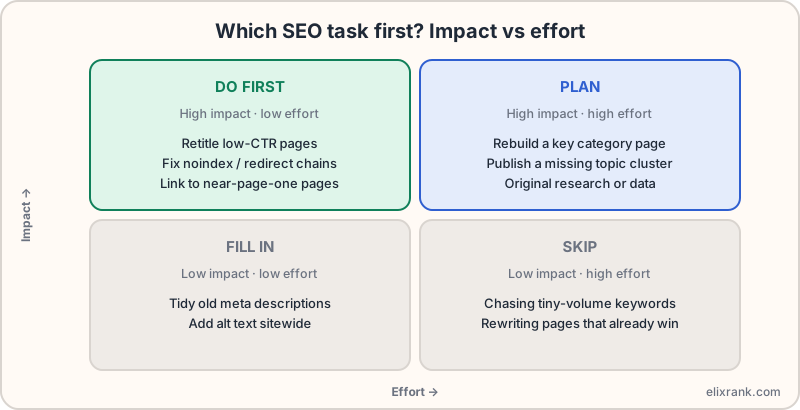
- Do first: high impact, low effort.
- Plan: high impact, high effort. Schedule these.
- Fill in: low impact, low effort. Batch them when you have spare time.
- Skip: low impact, high effort. Don't.
Use real data to score impact
Impact is a guess unless you anchor it to numbers. Search Console gives you three useful signals:
- Impressions: demand. High-impression pages have the most to gain.
- Position: how close the page is to the top of page one. See striking distance keywords.
- CTR versus pages at a similar position: how much the snippet is losing.
A page with high impressions, a position near 8 and below-normal CTR is almost always a better first task than anything off-site or sitewide.
Estimate effort honestly
- Low: under an hour, one page, no developer (title, description, internal link).
- Medium: a few hours, one or a few pages (rewrite sections, add a FAQ).
- High: days, multiple people or a developer (new page cluster, template change, migration).
A worked example
Imagine four tasks from a small site's audit:
- Retitle /pricing (8,000 impressions, position 8, weak CTR): high impact, low effort. Do first.
- Build a new topic cluster for a missing subject: high impact, high effort. Plan for next month.
- Add alt text to 40 old images: low impact, low effort. Batch it.
- Rewrite the top-ranking homepage: low incremental impact, high effort and risk. Skip.
The first task takes under an hour and has the clearest evidence. That is the order the matrix gives you.
Keep the list short
- Pick the top three tasks. Not ten.
- Write the date and the expected effect next to each.
- Review results after 2–4 weeks.
- Re-score the list monthly; new data changes the order.
ElixRank returns audit findings already ranked by likely impact, so you start from the top of the matrix instead of building it by hand.
Frequently asked questions
How do I prioritise SEO tasks?
Score each by expected impact and effort, anchor impact to Search Console data, and do high-impact, low-effort tasks first.
What should I fix first in SEO?
Technical blockers such as noindex tags and broken redirects, then pages with high impressions that sit near page one or under-click.
How many SEO tasks should I work on at once?
Around three. Fewer, finished changes are easier to measure than many half-done ones.
Get the ranked list instead of building it
ElixRank orders your fixes by likely impact from your Search Console data.
Try ElixRank free →