GEO vs SEO: what's different and what's the same
By ElixRank Team · Updated
Short answer
SEO aims to rank pages in a list of search results. GEO (generative engine optimization) aims to have your content used and cited inside AI-generated answers. They share the same foundation: crawlable, indexable, well-structured pages with real expertise. GEO adds a focus on direct answers, quotable facts and AI crawler access.
GEO and SEO side by side
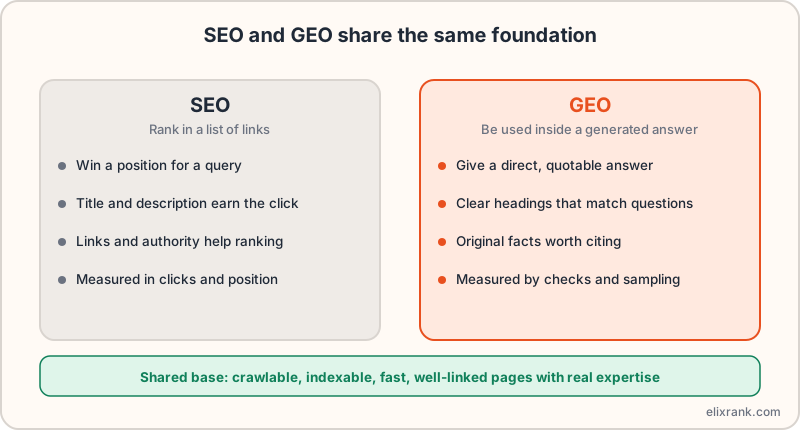
The terms GEO, AEO (answer engine optimization) and AI SEO overlap heavily. All describe making content easy for AI answer systems to find, understand and cite. The field is young, so vocabulary and measurement are still settling.
What stays the same
- Pages must be crawlable and indexable.
- Content must be useful, accurate and written by someone who knows the subject.
- Clear site structure and internal links still help engines understand your pages.
- Speed and a good page experience still matter to people, who still click.
If your SEO fundamentals are broken, GEO work will not rescue them. Fix indexing first with the meta tags analyzer and sitemap validator.
What GEO adds
Direct, quotable answers
Put a one or two sentence answer directly under each question-style heading, then support it. This gives an assistant a clean passage to lift.
Specific, original facts
Original data, clear definitions and precise numbers give an assistant something worth citing rather than a generic paraphrase of everyone else.
AI crawler access
Some sites block AI crawlers in robots.txt without intending to. Test it with the robots.txt tester. Whether you allow each crawler is a business decision, but make it deliberately.
Structured data
FAQ, Article and Organization markup help machines parse a page. Validate it with the schema markup validator. Markup is not a guarantee of citations.
How to measure GEO
Measurement is the weak spot. There is no single report that tells you how often you are cited. Practical options today:
- Search Console impressions and clicks for question-style queries.
- Referral traffic from AI products in your analytics, where they send a referrer.
- Manual spot checks: ask the assistants your target questions and note whether you are cited.
- Readiness audits for crawler access, structure and schema.
A 10-minute GEO checklist
- Confirm key pages are indexable.
- Check robots.txt for the AI crawlers you want.
- Add a direct answer under each question-style heading.
- Add one original fact, number or example to each key page.
- Add and validate FAQ or Article schema where it fits.
- Make sure each page has one clear topic and a descriptive title.
Frequently asked questions
What is the difference between GEO and SEO?
SEO aims to rank a page in search results. GEO aims to have content used and cited inside AI-generated answers. They share the same technical foundation.
Is GEO replacing SEO?
No. Crawlability, quality content and links still underpin both, and most AI answers rely on pages that search engines can find.
Is GEO the same as AEO?
The terms overlap. Both describe optimising for AI-generated answers.
Can I track citations?
Not completely. Combine Search Console data, AI referral traffic and manual spot checks.
Audit your AI-search readiness
ElixRank checks crawler access, structure and schema, and labels its scores as heuristics.
Try ElixRank free →